
DRY RUN 01 · ELEVATOR · PROCEDURE SHEET
What to do if your elevator falls (or just stops)
SHORT ANSWERPROCEDURE · SOURCED
If the car drops and then stops, the safety brakes worked. Stay inside. Stand at the back, facing the doors. Press and hold the alarm until a person answers. No answer and you have signal: call 911. Don't pry the doors, don't climb out, don't use the ceiling hatch. Wait for building staff or firefighters.101114
Watch the dry run

DRY RUN 01 · 6:12 · CHAPTERS
Your Elevator Is Falling. Jump or Lie Down?
Why elevators almost never fall
A traction elevator in a building this tall hangs on steel ropes, usually four to eight of them, each rated to hold the car on its own. If the car still goes too fast, a speed governor trips and sets the safeties: brakes that clamp onto the guide rails.2
Elisha Otis demonstrated the idea in New York in 1854: he stood on a platform, had the rope cut, and it dropped a few inches and stopped.4
US elevators and escalators together are linked to roughly thirty deaths a year, and many of those are people working on the machines, not riding them.1
This sheet covers traction (rope) elevators in mid- and high-rise buildings. Hydraulic elevators work and fail differently.3
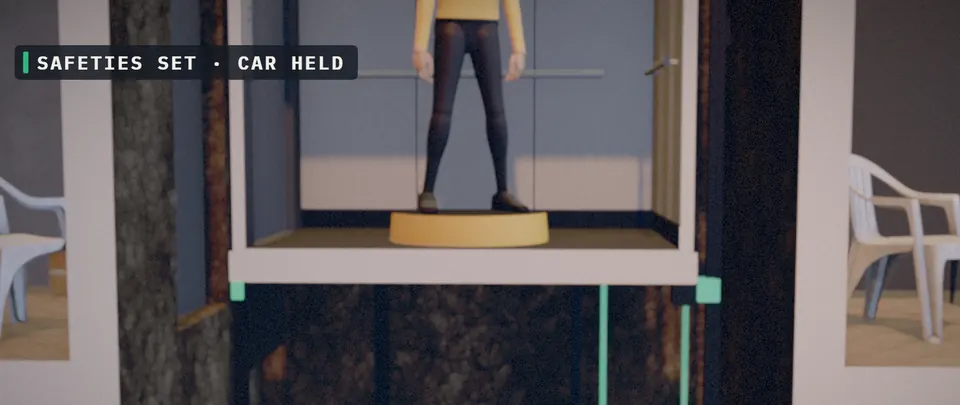
The procedure: stuck in an elevator, what to do
Notice that it stopped
A car that drops and then stops has had its safety system do its job. You are not in a falling elevator anymore. You are in a stuck one.2
Stay inside the car
A stalled car can move again at any time. While it's stopped, the inside of the car is the safest place to be, even if the doors open and the hallway looks close.1012
Stand back, center, facing the doors
New York City's elevator guidance says to move to the back of the car, in the center, and face the doors.11
Press and hold the alarm until a person answers
Not a beep. A human. Keep holding until someone confirms help is coming.1411
No answer? Call 911 if you have signal
Tell them where you are: the building address and which elevator. "The one I'm in" is not a location.1410
No signal? Shout
Shouting is allowed. Kicking or banging the doors is not: it damages the equipment rescuers need to work.10
Don't pry the doors or use the ceiling hatch
Never exit a stalled elevator without building staff or responders. The hatch is for rescuers; on modern cars it is kept locked and opened from outside.1113
Wait
Most of the time, the doors open in a few minutes. Bored is the goal.10

The three decisions
A IS USUALLY THE MOVIE ANSWER
INJECT 01-1 · DECISION 1CALDER CO.
“You're on the fourteenth floor. The elevator just dropped one floor. And stopped.”
INJECT 01-2 · DECISION 2CALDER CO.
“The doors slide open about a foot. The hallway floor is at your chest. It would be an easy climb.”
INJECT 01-3 · DECISION 3CALDER CO.
“The lights go out. The emergency light comes on. You look up, and there's a hatch in the ceiling.”
Myths vs facts
MYTH
Jump right before impact and you'll be fine.FACTA 14-floor free fall ends near 60 mph. Your best jump removes 2 to 3 mph, and you're nearly weightless, so you can barely push off. MythBusters (2004): busted.567
MYTH
Elevator cables snap all the time.FACTTraction cars hang on several steel ropes (usually 4 to 8), each rated to hold the car, plus a speed governor and rail brakes. Deaths are rare, and many involve workers, not riders.12
MYTH
Climb out through the ceiling hatch, like in the movies.FACTThe hatch is for rescuers. On modern cars it is locked and opened from outside. The roof of the car is a dark, greasy workplace with moving parts.131
MYTH
If the doors open a little, climb out to the hallway.FACTA stalled car can move again at any time. Don't exit without building staff or responders.1011
MYTH
After this, take the stairs.FACTStatistically, the stairs are the riskier choice.15
EXPERTS DISAGREE
Experts disagree: how to lie in a free fall
Lie flat, arms over head
Spreads the force across the whole body. The most-cited answer.68
Against lying flat
Your head and organs still take the full impact. There may be debris. Getting flat while nearly weightless is harder than it sounds.6
Bent knees
Some swear by it. Others say it just injures your legs first.6
We don't settle it. In a true free fall no position guarantees anything. Luck is not a procedure.
REAL CASE · NOT STAGEDCALDER CO.
One real case
On July 28, 1945, a B-25 bomber hit the Empire State Building. Elevator operator Betty Lou Oliver fell 75 floors in a car. She broke her neck, back and pelvis, and she recovered; Guinness lists it as the longest fall survived in an elevator. What slowed the car was cut cable piling up at the bottom and air compressed in a tight shaft, not her posture.97
Your slip
The correct string tonight is B-B-B. * The asterisk says "it already stopped."
Every real slip carries a checksum. Clone channels copy the scenario. They don't get the checksum.
Questions people search
What should you do if an elevator falls?
If it drops and then stops, the safety brakes worked: stay inside, stand at the back facing the doors, and hold the alarm until a person answers. A true free fall needs every rope, the governor and the safety brakes to fail at once, which almost never happens. In that case lying flat on your back is the most-cited position, but experts disagree and nothing is guaranteed.
Should you jump right before a falling elevator hits the bottom?
No. From 14 floors the car would hit near 60 mph, and a jump removes only 2 to 3 mph. You are also nearly weightless in free fall, so you can barely push off. MythBusters tested the last-second jump in 2004 and called it busted.
What do you do if you're stuck in an elevator?
Stay in the car. Press and hold the alarm until a person answers. If nobody answers and you have signal, call 911 and give the building address and which elevator. If there's no signal, shout. Don't pry, kick or bang on the doors, and wait for building staff or firefighters. Most of the time the doors open within a few minutes.
Should you climb out through the elevator ceiling hatch?
No. The hatch is for rescuers. On modern elevators it is kept locked and opened from outside, and the car roof is a dark, greasy work area with moving parts.
Is it safe to climb out if the elevator doors open between floors?
No. A stalled car can move again at any time, and below the hallway floor is an open shaft. Never exit a stalled elevator without building staff or responders.
Are elevators safer than stairs?
Statistically, yes. US elevators and escalators are linked to roughly 30 deaths a year, many of them workers, and stairs are the riskier choice.
Sources
Procedures were checked against these. Where a source is a summary of a code, we say so. Spot an error? Comment on the video or email business@dryruninstitute.com and we'll pin the correction.
- [1] CPWR (Center to Protect Workers' Rights) (2006). Deaths and Injuries Involving Elevators and Escalators
- [2] Live Science / NBC News (N. Gerbis) (2011). How to Survive an Elevator Free Fall
- [3] Live Science / NBC News (2011). How to Survive an Elevator Free Fall (hydraulic elevators, scope note)
- [4] ASME (accessed 2026). Elisha Graves Otis
- [5] Basic physics. Free fall, v = √(2gh): 42 m ≈ 29 m/s ≈ 64 mph (3 m per floor, no air resistance)
- [6] Live Science / NBC News 2011; University of Illinois Physics, Ask the Van (2011). Jumping, lying flat and bent knees in a falling elevator
- [7] MythBusters (2004). Elevator of Death (aired October 6, 2004)
- [8] NPR, Krulwich Wonders (citing Mary Roach) (2010). How to Survive When Your Elevator Plunges
- [9] Guinness World Records (2023). Longest fall survived in a lift (elevator): Betty Lou Oliver, 1945
- [10] Technical Safety BC (2019). Stuck Elevator? 3 Things You Must Know
- [11] NYC Department of Buildings (2025). Elevator Safety
- [12] Elevator Escalator Safety Foundation, via Safety+Health Magazine (NSC) (accessed 2026). The dos and don'ts of elevator safety
- [13] TK Elevator; ANSI (ASME A17.4 summary) (2015 / accessed 2026). Classroom on Demand: Emergency Exit; ASME A17.4-2015 Emergency Personnel for Elevators
- [14] Case Western Reserve University (2023). Emergency Procedures 5218-01
- [15] Live Science (2011). Despite Fatal NYC Accident, Elevators Still Safer than Stairs
Fiction framing. Procedures are real. Not a substitute for professional training. Calder County, June Hadley and the tabletop are fictional. The EXERCISE ODDS readout in the video is a tabletop estimate, not a statistic. In a real emergency, call 911 and follow instructions from responders on scene.